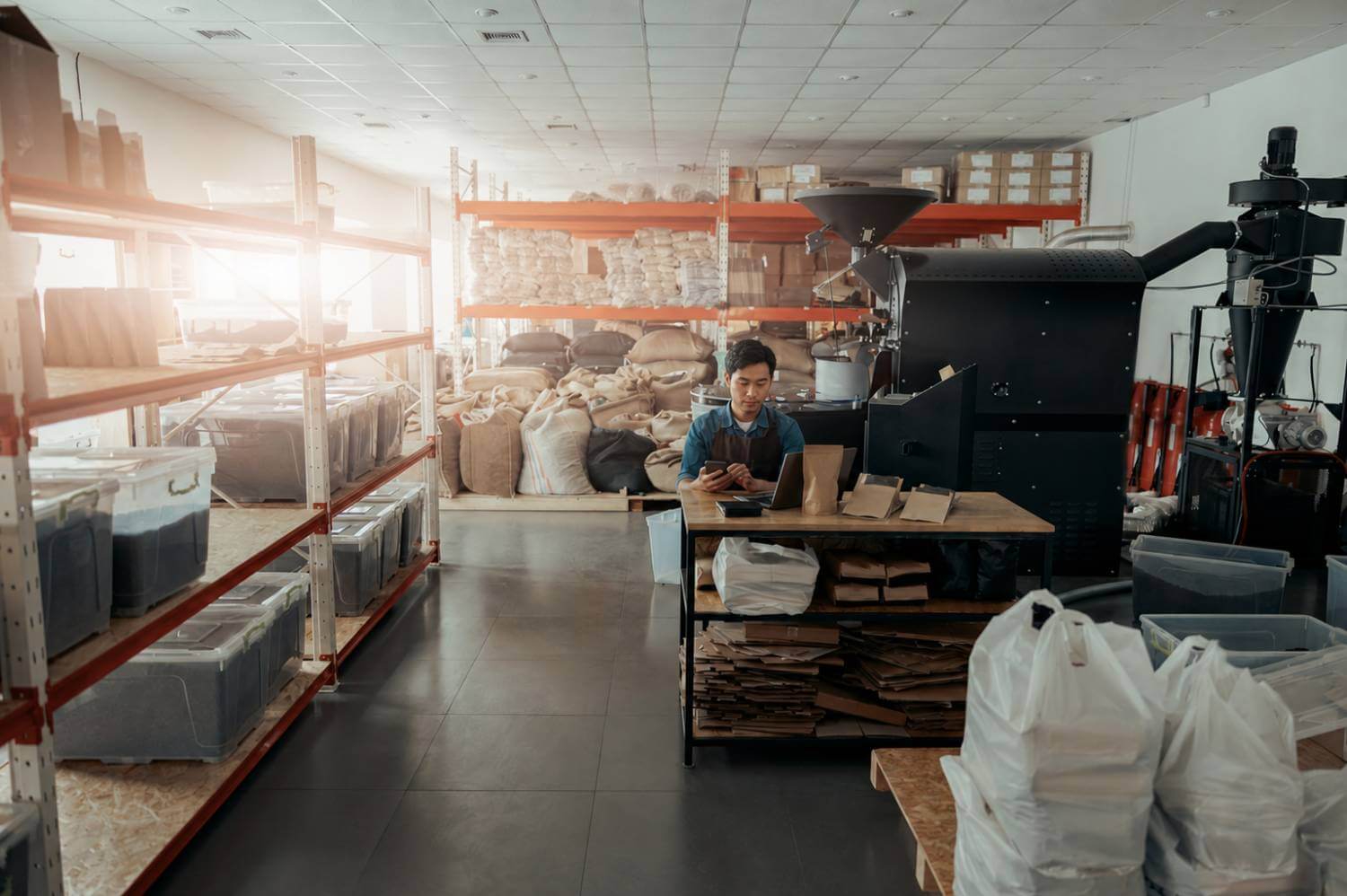
How JK Capital helps Filipino wholesalers bridge the gap between paying suppliers and getting paid by buyers, before the next opportunity passes by.
Talk to any wholesaler in Divisoria, Malabon, or Cebu City, and you will hear a version of the same story. The hardest part of the business is rarely selling. It is the interval in between.
You have settled with your suppliers. The trucks have rolled out. The goods are already on the supermarket’s shelves. But the receivable is sixty days away. Sometimes ninety. And in the meantime, another supplier is on the phone, another contract is sitting on your desk, and you are trying to work out how to commit to either one without drawing your account down to nothing.
If that describes your week, you are in good company. And in 2026, the squeeze is tightening, not easing.
What the market is actually doing right now
In March 2026, Philippine inflation accelerated to 4.1%, nearly double the 2.4% recorded in February. Transport inflation alone swung from a slight contraction to a 9.9% year-on-year increase in the span of a single month. By April, headline inflation had climbed to 7.2%, with transport costs up 21.4%. That is not a gradual squeeze. It is a sharp upward step in your operating costs.
Local shipping lines responded almost immediately. FastCat and Starlite implemented roughly 25% cargo rate increases in March 2026, citing the global fuel surge linked to the Middle East conflict. If your operation moves goods between Luzon, Visayas, and Mindanao, you have felt the impact on every consignment.
Now overlay that on the structural mechanics of wholesale. Suppliers expect payment up front, or close to it. Institutional buyers, meaning supermarkets, government agencies, hotels, restaurant groups, settle on their own timetable rather than yours. The gap between the two is where most wholesale operators live. That gap has simply grown wider, and more expensive, than it was a year ago.
Why a traditional bank facility may not be the answer right now
Banks have their place. If your timeline allows for months of processing, your documentation is fully in order, and you have an established relationship with your account officer, a bank facility is often the lowest cost of capital available to you.
Wholesale, however, does not operate on bank timelines. Supplier deadlines are measured in days. A volume discount window from your manufacturer might close by Friday. A supermarket contract goes to the distributor who can move first. By the time a traditional facility clears, the opportunity has typically gone to a competitor who had capital on hand.
That is the part the textbooks tend to leave out. The opportunity cost of a missed contract almost always exceeds the cost of slightly more expensive financing. The arithmetic looks different when you are the one signing for the inventory.
Example Scenario:

Consider one operator we worked with. Call him Anthony. He runs a dry goods wholesale business out of Malabon.
A major supermarket chain offered him a quarterly supply contract valued at ₱2.8 million, the largest order he had ever been quoted. The condition was that he settle with his upstream suppliers within fifteen days in order to lock in the agreed pricing.
He had ₱800,000 in working capital. He needed ₱2.5 million. His bank indicated the facility would take, in their words, a few weeks, possibly a month or two. The supermarket was not willing to wait.
Anthony submitted his application with us on a Monday. The funds were in his account the following week. He paid his suppliers, fulfilled the order on schedule, and once the supermarket settled sixty days later, he repaid the loan in the agreed terms with enough margin remaining to expand his warehouse footprint. That contract is now a recurring one.
The loan itself was not the story. The story was that he was positioned to act the moment the opportunity opened.
Talk to us about your next big order.
How we structure financing around how wholesalers actually operate
We have been financing Philippine SMEs since 2014. Over ten thousand of them. A substantial portion of that book has been wholesalers, distributors, and importers, which is why our products are built around the cash conversion cycle of this industry rather than around generic SME assumptions.
Unsecured Working Capital Loans. When a supplier deadline falls in days and your receivable is still sixty out, this is the relevant instrument. We lend between ₱300,000 and ₱50 million in terms of three to six months, with minimal documentation and a streamlined approval process built for speed. It is designed to bridge, not to sit on your balance sheet for years. You draw on it to secure the purchase, then retire it when the receivable comes in.
Secured Loans for Larger Inventory Positions. If you are pursuing something more substantial, perhaps locking in a full year of inventory before pricing climbs again, or scaling up your warehouse capacity, a secured facility gives you more room to operate. The same ₱300,000 to ₱50 million range applies, but with collateral such as real estate, heavy equipment, or a vehicle, you can extend terms up to twenty-four months. Larger ticket, longer runway.
Post-Dated Check Rediscounting. This is the underused one. If your institutional buyers pay in post-dated checks, and most of them do, there is no operational reason to hold those checks until maturity. We rediscount them and place the cash in your hands now, freeing you to deploy it on the next order. With shipping and fuel costs moving the way they are, sitting on a PDC until it clears is, in practical terms, leaving margin on the table.
What "fast" actually means in our process

Our standard is five to seven business days from completed application to released funds. That is not a marketing line. It is the operating benchmark we hold ourselves to, because we are aware of what a few weeks costs you. We have seen wholesale operators arrive at our door after a bank told them the facility was coming soon, only to discover the contract had already moved on while they waited.
We also evaluate your business the way you would want a lender to evaluate it. Not solely bank statements and ITRs, but purchase orders, buyer mix, receivables aging, and inventory turnover. The full operating picture, rather than only the lines that fit a standardized form.
The broader context
Wholesale and retail trade is the single largest contributor to Services-sector GDP growth in the first quarter of 2026, outpacing both financial services and transport. It is the sector that keeps Philippine shelves stocked and communities supplied. Yet the operators running it are working on margins that leave little room for delay, against a financing system that has historically not kept pace with the speed at which their work moves.
That is the gap we exist to close. Not with a pitch, but with capital you can actually deploy, on a timeline that aligns with how your business is paid.
If you are weighing an opportunity right now
If a supplier has just sent you a quotation and you are calculating whether you can commit, speak with us before you decline. We finance between ₱300,000 and ₱50 million, released within five to seven business days, on terms structured around how wholesalers are actually paid.
Over a decade in operation. More than ten thousand SMEs were funded. We are not a bank, and in this market, that is precisely the point.
See what financing built for wholesalers actually looks like.
JK Capital Finance is that partner.
For every ambitious business, having the right partner is essential, and JK Capital is here to fuel SME growth. We provide financing from ₱300,000 to ₱50 million, released in just 5–7 days, so you can elevate your business without delay.
At JK Capital, we evaluate each customer’s financial structure and develop tailored funding strategies that align perfectly with their operations and objectives. With over a decade in the industry and more than 10,000 SMEs funded, we transform business potential into measurable growth. Beyond capital, we are your steadfast partner in achieving breakthroughs — especially when the times are tough.